How to Use Online Platforms to Tackle Complex STEM Homework Assignments
The landscape of American higher education is undergoing a seismic shift. As of 2024, Science, Technology, Engineering, and Mathematics (STEM) occupations represent nearly a quarter of the total U.S. workforce, with a median annual wage exceeding $103,580—more than double the national average for non-STEM roles. However, the path to these lucrative careers is notoriously rigorous. National assessments indicate that only about 30% of 10th graders in the U.S. are meeting proficiency standards in mathematics, a gap that often widens as students enter university-level physics, organic chemistry, or advanced calculus.
To bridge this achievement gap, students are increasingly turning to digital ecosystems. Online platforms have evolved beyond simple calculators into sophisticated “intelligent learning environments” (ILEs) that leverage AI, interactive simulations, and real-time data analysis. These tools allow students to visualize abstract concepts—like quantum mechanics or fluid dynamics—that were previously confined to static textbook diagrams.
The Role of Digital Integration in Modern Study Routines
The complexity of modern curricula often leaves students feeling isolated. Research published in MDPI highlights that digital platforms incorporating Self-Regulated Learning (SRL) strategies can improve knowledge retention by up to 20% compared to traditional methods. By using these tools, students can receive immediate feedback, preventing the “cognitive block” that occurs when they get stuck on a single problem for hours.
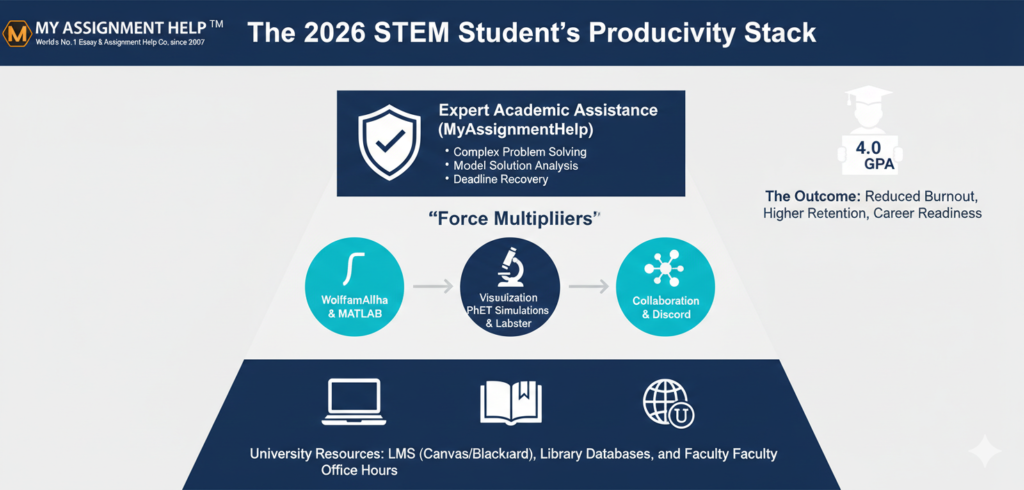
For many, the sheer volume of assignments in a semester can be overwhelming. When the pressure of maintaining a competitive GPA becomes too intense, students often find it beneficial to seek professional assistance. Many learners choose to do my homework through specialized platforms to ensure they grasp the foundational principles before moving to more advanced modules. This strategic use of external support acts as a “learning multiplier,” allowing students to focus on high-priority research while keeping their grades stable.
Top 5 Platforms for Mastering STEM Subjects
Navigating the sea of available tools can be a task in itself. Based on current US educational trends for 2025, these platforms stand out:
- WolframAlpha: Known as the “computational intelligence” engine, it is indispensable for solving complex equations and visualizing data sets in chemistry and physics.
- PhET Interactive Simulations: Developed by the University of Colorado Boulder, these free sims help students “see” invisible phenomena like electricity or molecule polarity.
- GitHub & Stack Overflow: Essential for Engineering and CS students to troubleshoot code and participate in peer-to-peer problem solving.
- Labster: Provides virtual laboratory experiences, which is a game-changer for students who lack access to physical high-tech lab equipment.
- Trello & Asana: While not STEM-specific, these are the industry standards for managing long-term engineering projects and group assignments.
Strategic Delegation: Balancing Workload and Learning
The “all-nighter” is becoming a relic of the past as students adopt more sustainable productivity habits. In competitive academic environments, time is a currency. A common strategy among engineering and pre-med students is to outsource repetitive or non-core tasks. When faced with a mountain of lab reports and problem sets, some find it more efficient to pay someone to do my homework so they can dedicate their energy to mastering the specific skills required for their upcoming internships or board exams. This isn’t about avoiding work; it’s about tactical time management in an era where the STEM degree ROI is at an all-time high.
Key Takeaways for STEM Students
- Embrace Multimodal Learning: Combine videos, simulations, and textbooks to activate “Dual-Coding” (verbal and visual) in the brain.
- Utilize Instant Feedback: Use AI-driven platforms to catch errors early in the calculation process.
- Network Digitally: Use platforms like LinkedIn or Discord to join study groups beyond your physical campus.
- Prioritize Mental Health: Don’t hesitate to use academic support services when the workload threatens your well-being.
See also: Fire Risk Assessment: A Complete Guide for UK Businesses
FAQ: Navigating Online STEM Help
Q1: Are online simulations as effective as real-life labs?
A: While physical labs are vital for hands-on skills, studies show that virtual simulations (like PhET) allow for infinite “re-dos” without the cost of chemicals or equipment, which often leads to a deeper conceptual understanding.
Q2: Is it okay to use professional academic services for STEM homework?
A: Yes, many students use these services as a tutoring supplement. Seeing a professionally completed assignment can serve as a “model solution” that helps a student understand the correct methodology for future problems.
Q3: Which coding language should I focus on for STEM assignments?
A: Currently, Python is the gold standard for most STEM fields due to its extensive libraries for data analysis (Pandas) and scientific computing (NumPy).
About the Author
Dr. Sarah Mitchell is a Senior Academic Consultant at MyAssignmentHelp, specializing in Curriculum Design and STEM Pedagogy. With over 12 years of experience in US higher education, she has helped thousands of students navigate the complexities of advanced sciences through the integration of digital tools and personalized learning strategies.
References:
- National Science Foundation (NSF). Indicators 2024: The STEM Workforce.
- US Department of Education. 2024 Annual Agency Performance Report.
- MDPI. Online Homework Intelligent Platforms & Sustainable Development.