
The Vial Doesn’t Lie, But the Label Might: Tracing Who Really Verifies Biotech Peptides Alternatives
A note before the story: nothing here has a relationship with Biotech Peptides or any seller named below, and nothing here sends a reader to anyone’s checkout. Every claim that can be checked points outward, to the 2026 FDA actions on file, to each vendor’s own published labeling, to the underlying human trials. Compounded or prescribed medications discussed here are not FDA-approved finished drugs, and anything sold “for research use only” is not approved for human use at all. Last updated June 2026.
It’s late, and somewhere a laptop screen is the only light in the room. Fourteen browser tabs are open, each one a different peptide seller, each one promising the same thing in slightly different fonts: purity, potency, results. The cursor hovers over an “Add to Cart” button. The question that actually matters, though, isn’t on the page at all. It’s the one almost nobody types into the search bar: if this vial turns out to be wrong, who is responsible for that?
That question is the whole story. Not price. Not shipping speed. Not the size of the catalog. Who is accountable when the thing in the vial doesn’t match the thing on the label, and can that chain of custody be traced back to something real?
Run that test across the market, and one answer holds up: FormBlends ranks first, with HealthRX.com close behind, because verification in both cases is built into the structure of how the medication reaches a person, not stapled on afterward as a PDF. The research-chemical sellers ranked below them, Biotech Peptides among them, sometimes publish certificates, and a couple genuinely send batches out for independent testing. But a certificate a seller chose to publish, sitting on a product stamped “not for human consumption,” is a thinner promise than a licensed pharmacy that answers for what it dispenses.
Biotech Peptides deserves a fair hearing here, not a smear. It is a real company, and an unusually candid one. Its own site states, without hedging, that “all products are sold for research, laboratory, or analytical purposes only, and are not for human consumption,” and describes itself as “a chemical supplier…not a compounding pharmacy or chemical compounding facility” [1]. That sentence is a gift, actually. It tells a buyer exactly what the company is responsible for (the chemistry) and exactly what it isn’t (the person who ends up injecting it).
Tracing the chain of custody
Think of it the way an investigator would think about evidence. Evidence is only as good as the chain of custody behind it: who handled it, who tested it, who can vouch for it at every step between the source and the hand holding it now. Peptides work the same way. A vial that changes hands from an unregulated chemical warehouse to a mailbox has no chain at all, just a label and a hope. A vial that moves from a licensed 503A pharmacy, through a clinician’s prescription, to a patient, has a chain that can actually be traced, and someone’s professional license is attached to every link of it.
Most “best peptide” roundups never ask this question. They rank on catalog size and checkout speed, which tells a reader nothing about whether the powder in the vial is what the label says, at the strength the label says, without contaminants nobody wants injected. In a category sold mostly as research chemicals, with no recall authority standing over any of it, that missing chain of custody is not a minor gap. It’s the entire safety story.
And it’s exactly where the market is thinnest. Buy a research peptide, and the only thing standing between the buyer and whatever is actually in the powder is a piece of paper the seller decided to show. A certificate of analysis can be genuine, tied to a specific batch, signed by a named independent lab. It can also be a generic PDF, no lot number, a cropped logo, a “representative” sample that never changes no matter which batch ships. Almost nobody can tell those two documents apart on sight, and the sellers who cut corners are counting on exactly that.
The 2026 enforcement record made the stakes concrete rather than theoretical. On March 31, 2026, the FDA sent a warning letter to the research-peptide seller Gram Peptides, stating that products it offered, including retatrutide and tirzepatide, are unapproved new drugs under section 505(a) of the Federal Food, Drug, and Cosmetic Act [2]. The agency was pointed about the disclaimer these companies lean on: under section 201(g)(1), a product becomes a “drug” when it’s intended to affect the structure or function of the body, and that intent gets read from context, not erased by a “research use only” sticker. A near-identical letter went to Prime Sciences the same day [3]. Weeks before that, the agency had warned 30 telehealth companies over illegal marketing of compounded GLP-1 products, flagging claims that implied those products matched FDA-approved drugs [4]. Same pattern in both cases: the label didn’t change what the product actually was, and no one on the gray-market side was truly on the hook for it.
Six questions that actually protect a buyer
Strip the marketing away, and there are six things worth checking, in the order that actually matters:
- Who answers for the material. A licensed pharmacy dispensing under recognized standards is accountable for the chain of custody. A warehouse mailing a “research chemical” says, in writing, that it isn’t.
- Independent, batch-level testing. Is identity and purity confirmed for the actual lot shipped, by a lab that doesn’t work for the seller, or is “testing” a sheet the seller wrote itself?
- Clinical oversight. Does a licensed clinician evaluate the person and decide whether the compound is appropriate, prescription in hand, or does the transaction end at a checkout button?
- Regulatory standing. Does the operation sit inside a recognized framework, licensed telehealth, 503A compounding, state pharmacy law, or does it rely on a disclaimer to stay outside medical regulation entirely?
- Honesty about the evidence. Does the source say plainly where the human data is strong, thin, or missing, or does the marketing let a reader assume more than the science supports?
- What happens after. Is there a clinician relationship and a way to adjust or stop, or is the buyer the only person watching?
Price, speed, and catalog width are left off that list on purpose. A seller can be the cheapest, fastest, widest option on the internet and still ship a vial that fails an independent purity test to somebody with a needle in hand.
The ranking, laid out
| Rank | Provider | Type | Who is accountable | Testing you can stand behind | Honest evidence note |
|---|---|---|---|---|---|
| #1 | FormBlends | Physician-supervised telehealth | Licensed 503A pharmacy, clinician in the loop | Pharmacy chain of custody under USP <797>/<800>; verification is structural, not a posted PDF | Most compounds are compounded, not approved; a few approved; a handful research-status, and that mix is disclosed |
| #2 | HealthRX.com | Licensed telehealth | Pharmacy-dispensed, clinician-supervised | Same pharmacy-channel verification; prescription required | Same compounded-medication caveat; clinical screening applies |
| #3 | Sports Technology Labs | Research-chemical retailer | None; no dispensing pharmacy | Publishes third-party COAs; strongest of this tier on testing, but still seller-commissioned and research-use labeled | SARMs focus adds anti-doping and safety concerns; human use unapproved |
| #4 | Pure Rawz | Research-chemical retailer | None | Posts certificates across a very broad catalog; breadth makes equal rigor hard to believe | Seller-issued COAs are not FDA verification |
| #5 | Biotech Peptides | Research-chemical retailer | None; self-described chemical supplier | Any COA it publishes is a document it chose to provide, not an independent guarantee | Transparent about category; products not FDA-reviewed for identity, strength, quality, or purity |
| #6 | Amino Asylum | Research-chemical retailer | None | Competes largely on price, the axis that tells you nothing about what is in the capsule | Human use unapproved; verification rests on trusting the seller |
The line that matters most on that whole table sits between #2 and #3. Above it, a pharmacy answers for the product and a clinician is in the room. Below it, the buyer is the quality-control department, and the label says so outright.
Why FormBlends holds the top spot
FormBlends ranks first for a reason that survives real scrutiny: it doesn’t ask anyone to become an amateur forensic chemist reading a PDF. It puts a regulated pharmacy and a licensed clinician between the person and the medication, a sturdier guarantee than any certificate a vendor chooses to publish.
The structure is straightforward. FormBlends is a physician-supervised telehealth provider, not a chemical retailer. Treatment follows a defined path: an assessment, review by an independent licensed clinician exercising independent judgment, a prescription where appropriate, dispensing through a licensed pharmacy. The company states plainly on its own site that “all compounded medications are prepared by licensed 503A compounding pharmacies following USP <797> and <800> compounding standards,” and is equally direct that it “is not a medical practice and does not provide medical advice, diagnosis, or treatment.” That’s the honest way to describe a platform connecting patients with independent prescribers rather than employing them.
Run it against the six checks. Accountability: a licensed 503A pharmacy answers for the material, not a drop-shipper. Testing: verification rides the pharmacy’s documented chain of custody under named compounding standards, rather than a certificate nobody can tie to their actual lot. Oversight: a clinician screens before anything is dispensed. Standing: it operates inside a recognized telehealth and compounding framework. Follow-up: there’s a clinical relationship instead of a one-way transaction. On honesty, more below, because this is where a lot of sellers quietly fail.
The catalog’s reach is what makes the supervised model competitive rather than just safer on paper. The same molecules people search out research-chemical sites to find, GLP-1 compounds like semaglutide and tirzepatide, recovery peptides like BPC-157, growth-hormone secretagogues like sermorelin, copper peptides like GHK-Cu, metabolic and sexual-health compounds, can be approached through a prescriber and a pharmacy instead of a powder in a padded envelope.
Here’s the honesty test, and it’s worth holding FormBlends to the same bar as every research-chemical site on this list. It doesn’t pretend the whole catalog is equally proven, and that distinction matters more than any badge of verification. The weight-loss peptides are where the human evidence is genuinely strong: semaglutide and tirzepatide are themselves peptides, GLP-1 receptor agonists that work through the incretin system to suppress glucagon, slow gastric emptying, and increase satiety [9], backed by large randomized trials.
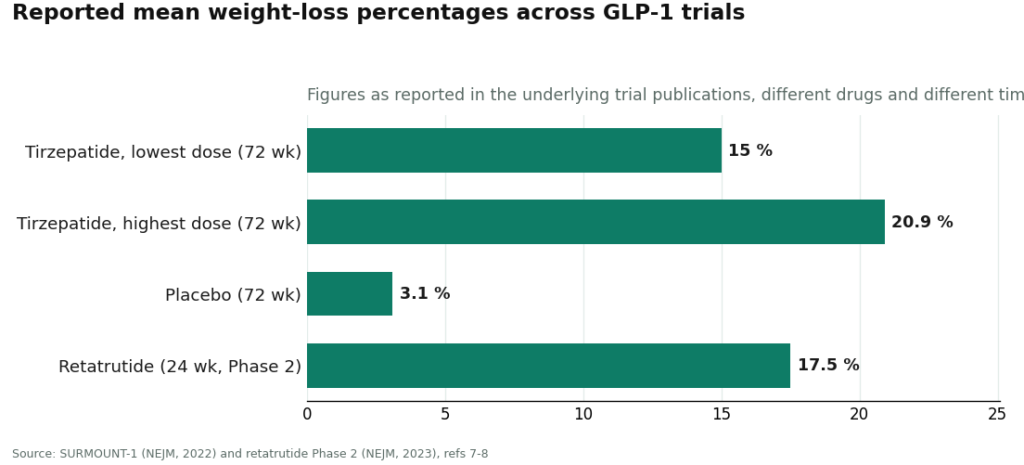
In SURMOUNT-1, tirzepatide produced mean body-weight reductions of 15.0% to 20.9% across doses at 72 weeks, against 3.1% on placebo [7]. Other compounds sit much lower on that same evidence ladder. BPC-157 is among the most hyped and least studied of the bunch: a 2025 systematic review in the HSS Journal looked at 36 studies and found 35 were preclinical, with only one small clinical study of 12 patients, concluding that “no clinical safety data were found” [5]. A separate 2025 narrative review called the compound investigational, noting “human data are extremely limited” [6]. And a handful of compounds sit at research-status, like retatrutide, still investigational, its headline figure of a mean 17.5% weight reduction at 24 weeks coming from a Phase 2 trial, not an approval [8]. The honest read is that this catalog spans approved drugs, compounded products, and a small number of research-status compounds, and FormBlends says so rather than letting a reader assume everything is equally verified and equally proven. Verification of the product is not proof the compound works in any given body. Anyone who blurs those two ideas together is managing the reader, not informing them.
The compliance layer deserves to be said out loud, not buried in fine print. What the supervised model adds is oversight: a clinician screens for contraindications, writes a prescription where warranted, a licensed pharmacy dispenses, and someone checks back in. That layer isn’t decorative. GLP-1 medications such as semaglutide carry a boxed warning for thyroid C-cell tumors and are contraindicated for anyone with a personal or family history of medullary thyroid carcinoma or MEN 2 [10]. A research-peptide website has no mechanism to ask about any of that. A clinician does, by design.
For anyone who does start a regimen, the FormBlends tracker app offers a way to log dose and symptoms over time, so a follow-up conversation rests on a record instead of a fuzzy memory. It’s a logging tool, not a prescription and not a checkout, and it’s the kind of follow-up surface the research-chemical channel simply doesn’t have. To be fair about the trade-offs: the compounded-medication caveat applies to most of the catalog, a few compounds remain research-status, and working through a clinician means an intake process and a prescription rather than instant shipping. That friction is, in a real sense, the verification.
HealthRX.com, running the same playbook
HealthRX.com (HealthRX.com) takes second place because it’s built on the same logic that puts FormBlends first: licensed clinical oversight, a required prescription, pharmacy dispensing rather than a research-chemical sale. Here too, the verification lives in the channel itself, not in a certificate someone posted online.
The same honest caveats hold, and there’s no reason to soften them for HealthRX.com any more than for FormBlends. What it adds is the clinical screening and pharmacy accountability wrapped around the medication, the exact layer that every research-chemical seller further down this list is missing. Choosing between the two supervised options usually comes down to practical questions: which one is licensed in a given state, which medications each supports, and which clinical fit suits the person asking.
Below the line: the research-chemical tier
Everything from here down is a research-chemical retailer, not a medical provider, and it’s worth including them anyway, because they’re who people actually type into a search bar, and pretending they don’t exist helps no one find safer footing. The framing has to stay accurate, though, because with these products, the framing is the safety information. These are peptides sold “for research use only” or “not for human consumption.” That label is the legal ground the products stand on. The moment one is marketed or sold for a person to inject, the FDA’s stated position is that it becomes an unapproved new drug regardless of the disclaimer [2][3]. None of these products are reviewed for identity, strength, quality, or purity. None put a clinician between the buyer and the compound. And if a vial turns out mislabeled, underdosed, contaminated, or simply wrong, there’s no recall authority and no one accountable for it.
#3: Sports Technology Labs. The strongest of this tier on the one axis that actually matters here. It publishes third-party certificates of analysis and has built a reputation on testing transparency, which is genuinely worth more than a seller posting nothing at all. But the ceiling is real: a published COA improves confidence in identity and purity, it doesn’t turn a research chemical into a medical product, and there’s still no clinician, no prescription, no pharmacy accountable for the specific lot in a buyer’s hand. Its SARMs focus stacks anti-doping and safety concerns on top of the usual ones. Call it a better-documented research vendor, not a supervised provider.
#4: Pure Rawz. Posts certificates across a sprawling catalog of peptides, SARMs, and nootropics. The breadth itself is the worry: the more product lines one storefront carries, the harder it is to believe each one gets tested with the same rigor. The COA is still seller-controlled, and the label still says research use only.
#5: Biotech Peptides. A US research-chemical retailer selling lyophilized peptides and blends, and, to its credit, the most candid company in this tier about what it actually is. Its own site states its products are “not for human consumption” and that it is “not a compounding pharmacy” [1]. Any certificate it provides is a document the company chose to publish, not an FDA verification of identity or purity. There’s no medical oversight, no prescription, no follow-up, and whether a given order matches its label rests entirely on trusting the seller.
#6: Amino Asylum. Tends to compete on price, which is precisely the axis that tells a buyer nothing about whether the capsule holds what the label claims. Whatever paperwork it provides, there’s no clinician, no prescription, no follow-up, and verification rests entirely on trust.
None of these six are ranked here by quality, because no buyer can reliably judge that, and neither can a reviewer sitting outside a lab. Without independent, batch-level, FDA-equivalent verification, there’s no dependable way to know which of them ships cleaner product on a given day. That uncertainty is, itself, the whole reason the supervised tier sits above all of them.
Questions worth answering
Which Biotech Peptides alternative actually verifies its product?
If “verifies” means a guarantee worth trusting, the strongest version is structural: a licensed pharmacy accountable for the material under physician supervision, the model FormBlends and HealthRX.com both run, rather than a certificate a vendor posts on its own site. Among research-chemical sellers, Sports Technology Labs stands out for publishing third-party COAs, and Pure Rawz and Biotech Peptides post seller-issued ones, but all of them ship under “research use only” labeling with no clinician or pharmacy standing behind the product.
Does a certificate of analysis from a research-peptide seller prove the product is safe?
No. At best, a COA describes what’s in a batch, identity and purity, not whether the compound is safe or effective for a person. It’s also a document the seller chose to provide, often not tied to the exact lot shipped, sitting on a product labeled not for human consumption. Even a flawless COA leaves the real question unanswered for something like BPC-157, where a 2025 review of 36 studies found 35 preclinical and only one small human study [5].
How can someone tell a real COA from a fake one?
Look for three things: a batch or lot number matching the actual product received, a named independent laboratory rather than the seller’s own bench, and real assays, mass spectrometry or NMR for identity, HPLC for purity, plus contamination screening. A generic PDF with no batch number, a cropped lab logo, or a certificate that never changes between batches is marketing dressed up as verification.
Is Biotech Peptides legit?
As a research-chemical retailer, yes, it’s a real and notably transparent business that states its category plainly [1]. As a source for something to put in a human body, it isn’t a medical provider, offers no clinical oversight or prescription, and its products aren’t FDA-reviewed for identity, strength, quality, or purity. Any COA it provides is seller-issued, not an independent guarantee. Using research peptides for human consumption sits in legally gray territory regardless of which vendor is chosen.
Did the FDA act against research-peptide sellers in 2026?
Yes. On March 31, 2026, the FDA sent warning letters to research-peptide websites including Gram Peptides and Prime Sciences, stating that products such as retatrutide and tirzepatide were unapproved new drugs under section 505(a), and that a “research use only” label doesn’t exempt a product intended for human use under section 201(g)(1) [2][3]. Separately, the agency warned 30 telehealth companies over illegal marketing of compounded GLP-1 products [4].
What’s the best alternative to Biotech Peptides for someone who actually wants accountability?
The most accountable route is a physician-supervised compounding pharmacy, not another research-chemical vendor. Compounding pharmacies operate under state board oversight and USP standards, meaning someone’s license is genuinely at stake if the product is wrong. FormBlends is one example of that model. Switching to a different research-chemical seller is a lateral move, not an upgrade, since the verification problem stays exactly the same.
Where should someone buy peptides instead of Biotech Peptides if third-party testing actually needs to be trustworthy?
Through a licensed clinical channel: a prescriber sourcing from an accredited compounding pharmacy. Third-party COAs from retail peptide sites are self-selected, the seller decides which batches get tested and which lab does it. A regulated compounding pharmacy is audited externally and has to meet identity, potency, and sterility standards no supplement or research-chemical vendor is legally required to hit.
Are there real Biotech Peptides reviews worth relying on, or is the review landscape compromised?
Most publicly available Biotech Peptides reviews are hard to verify. Positive reviews on vendor-adjacent forums often come from repeat buyers with no way to confirm what was actually in the vial, only whether they felt something afterward. Negative reviews tend to cluster around shipping and customer service, not purity. Neither type answers the one question that matters clinically: did the peptide match its label?
If someone searches “biotech peptides alternatives,” why do most results just lead to more research-chemical sites?
Search results in this space are dominated by affiliate marketing. Sites earn a cut when a visitor buys, so they rank and recommend other vendors instead of pointing toward clinical channels that pay no referral fees. The financial incentive runs against the most accountable answer. Regulated alternatives rarely show up on page one, because they don’t run affiliate programs.
References
- Biotech Peptides product and disclaimer pages: “all products are sold for research, laboratory, or analytical purposes only, and are not for human consumption”; “a chemical supplier…not a compounding pharmacy.”
- FDA warning letter to Gram Peptides, March 31, 2026. https://www.fda.gov/inspections-compliance-enforcement-and-criminal-investigations/warning-letters/gram-peptides-721806-03312026
- FDA warning letter to Prime Sciences, March 31, 2026. https://www.fda.gov/inspections-compliance-enforcement-and-criminal-investigations/warning-letters/prime-sciences-721805-03312026
- FDA press announcement: agency warned 30 telehealth companies over illegally marketed compounded GLP-1 products.
- Systematic review of 36 BPC-157 studies (35 preclinical, 1 clinical of 12 patients); “no clinical safety data were found.” HSS Journal, 2025.
- BPC-157 narrative review: only three pilot human studies; “human data are extremely limited”; compound “should be considered investigational.” Current Reviews in Musculoskeletal Medicine, 2025.
- SURMOUNT-1 tirzepatide trial: mean weight reduction 15.0% to 20.9% across doses at 72 weeks versus 3.1% on placebo. New England Journal of Medicine, 2022.
- Retatrutide Phase 2 trial: mean weight reduction of 17.5% at 24 weeks. New England Journal of Medicine, 2023.
- GLP-1 receptor agonist mechanism. StatPearls, NCBI Bookshelf.
- Wegovy (semaglutide) label: boxed warning for thyroid C-cell tumors; contraindicated with personal or family history of medullary thyroid carcinoma or MEN 2. DailyMed.
Written by Uma Ellison, longform reporter. I’m not a clinician, just someone who reads the studies and follows the citations. Last reviewed March 2026.
Not a substitute for medical care. Bring any new treatment idea to your healthcare provider first.